



Japanese Katana Sword Glossary
This glossary explains the main parts of a traditional Japanese katana. It is designed to help martial artists, collectors, and enthusiasts better understand the structure, terminology, and components of a samurai sword.
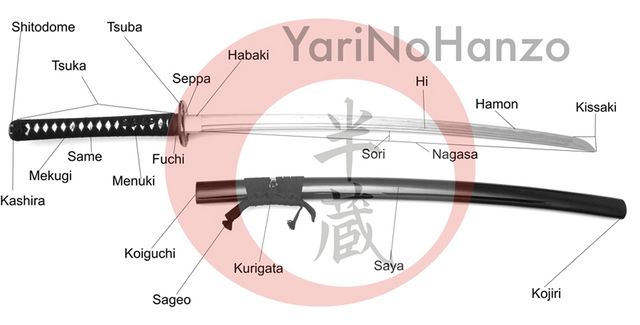
Katana Parts and Terminology
- Hamon: The visible temper line that separates the hardened cutting edge from the softer body of the blade.
- Kissaki: The tip of the blade, separated from the rest of the sword by the Yokote.
- Koiguchi: The opening of the Saya where the blade is inserted.
- Kojiri: The end piece of the Saya, also called Sayajiri.
- Kurigata: The knob on the Omote side of the Saya with a hole for the Sageo cord.
- Mei: The swordsmith’s signature, usually engraved on the Nakago.
- Mekugi-Ana: The hole in the Nakago used for the Mekugi peg.
- Mekugi: Usually a bamboo peg used to secure the Tsuka to the Nakago.
- Menuki: Decorative metal ornaments placed under the Tsuka-Ito to improve grip and handling.
- Moto-Haba: The width of the blade near its base.
- Moto-Kasane: The thickness of the blade near its base.
- Mune: The back edge or spine of the blade.
- Nagasa: The length of the blade, usually measured without the Habaki.
- Nakago: The tang of the blade, hidden inside the Tsuka.
- Sageo: The cord attached to the Kurigata of the Saya, traditionally used for securing the sword.
- Saki-Haba: The width of the blade near the Kissaki.
- Same: Ray skin placed over the wooden Tsuka core and under the Tsuka-Ito to improve grip.
- Saya: The scabbard of the sword.
- Seppa: Usually a pair of spacers placed around the Tsuba, between the handle and the blade fittings.
- Shitodome: Small metal fittings inserted into the Kashira for the passage of the cord.
- Sori: The curvature of the blade.
- Sugata: The overall shape and profile of the blade.
- Tsuba: The hand guard of the sword, often decorated in different styles.
- Tsuka: The handle of the sword.
- Tsuka-Ito: The cotton, silk, or leather braid used to wrap the Tsuka.
- Yokote: The demarcation line separating the main body of the blade from the Kissaki.
Learn More About Japanese Swords
Understanding the parts of a katana is essential when choosing a sword for collection, display, or martial arts practice. Explore our handmade katana collection to discover authentic Japanese-inspired swords crafted for real use.